
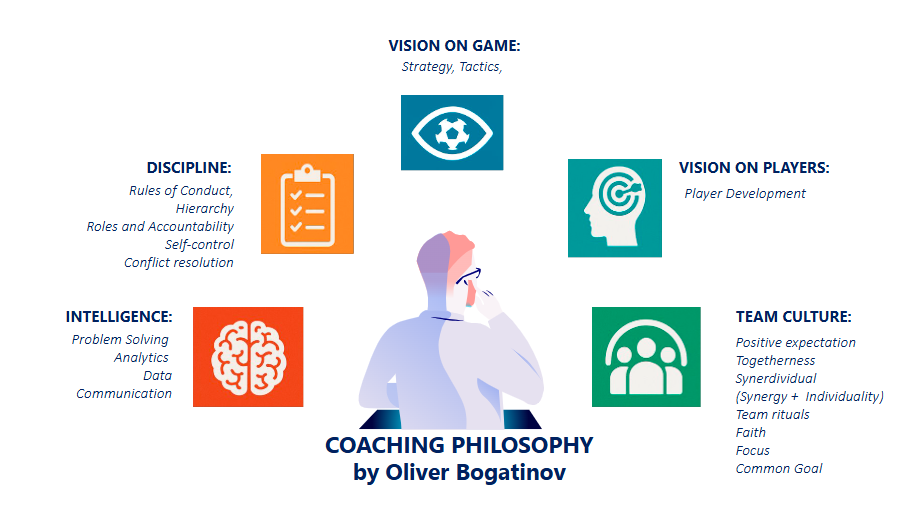
3 MAIN FIELDS OR CORESTONES OF COACHING PHILOSOPHY:
- VISION,
- DISCIPLINE AND INTELLIGENCE,
- TEAM CULTURE AND FAITH
Vision on game: The Foundation of Football Philosophy
Vision is a future-oriented philosophy that guides decision-making, intentional living, and long-term motivation. In coaching, vision must be personalized—rooted in the strategic strengths of both the team and the club, while also reflecting cultural and regional identity.
A clear vision provides direction and purpose. It shapes how we think about the game, how we develop players, and how we build a sustainable football culture.
From Vision to Game Model
From this vision, we derive the core premises and assumptions that form our game model—a structured representation of how we approach football. The game model reflects our beliefs about how the sport should be played, trained, and evolved.
Importantly, a game model cannot exist in isolation. It must be anchored in a clear vision. When foundational assumptions shift—due to changes in player profiles, competition demands, or club objectives—the game model must evolve accordingly.
Strategy: Understanding and Adaptation
Strategy is more than a plan; it’s a dynamic process grounded in deep understanding—of ourselves, our players, and our opponents. Even dominant strategies must remain flexible and responsive during play to stay effective.
The central question is: “What must we do to win?”
The answer lies in strategy. The “how”—the execution—belongs to the realm of tactics.
Tactics: Practice with Purpose
Tactics must be practiced consistently and intentionally. Vision helps us prioritize which tactical and technical elements to focus on, especially when preparation time is limited. This creates a coherent loop:
- Vision informs strategy
- Strategy guides tactics
- Tactics reinforce the vision
This cyclical approach ensures that every training session, match plan, and tactical adjustment aligns with our broader philosophy.
Innovation Through Integration
By aligning vision, strategy, and tactics, we create space for innovation. This approach has allowed us to:
- Develop new game strategies tailored to our identity
- Adapt tactics based on data analysis and performance trends
- Encourage fluid roles and positional flexibility to maximize individual and team strengths
Innovation is not just about doing something new—it’s about doing what’s meaningful, effective, and aligned with who we are.
Vision on Player: A Coach’s Mental Blueprint
A coach’s vision of a player is one of the most powerful tools in shaping both individual success and team performance. This vision goes beyond forecasting future achievements—it involves identifying and nurturing unique qualities that contribute meaningfully to the game. A well-developed vision allows coaches to unlock potential in ways that elevate not just the individual, but the collective.
Observation and Human Understanding
Understanding human nature is fundamental to effective coaching. It begins with the ability to observe—keenly, consistently, and sometimes critically. Great coaches possess the skill to notice subtle behaviors, interpret emotional cues, and make thoughtful distinctions between surface-level impressions and deeper truths. This capacity for deep observation and wise discernment is what separates good coaches from exceptional ones.
Integrated Player Development
From this foundation, a player development program takes shape—not as a standalone initiative, but as an integrated process within the broader training methodology. It’s a dynamic system that builds team chemistry while honoring individual identity. The goal is to shape players to thrive within a group context, while still preserving their personal essence—their “Kingdom.”
This approach ensures that each player grows not only in skill and tactical awareness, but also in confidence, character, and contribution. It’s a philosophy that balances collective cohesion with personal authenticity.
AND MUCH MORE…………..